
Another first for me, but in this case a most unwelcome one. This is the first time I have ever left the theatre before the end of a show, not because I wasn’t enjoying the production, far from it, but I have a medical condition, yes, another one, which, when it attacks, causes excruciating pain. It decided to make its entrance half way through the second act leading me to decide that the only way I could get any relief was to depart. Even that didn’t go to plan, as I was suffering so badly I had to sit outside on a bench for twenty minutes or so. Still finding no improvement I went back into the theatre where I asked if there was anywhere I could lie down. A very helpful young man directed me to a secluded part of the bar area where I stretched out for a while. By this time, the main part of the room, thankfully from where I’d not been visible during my semi-recuperation, was full of guests at the after show bash, but I managed to sneak out without drawing too much attention to myself. ‘Stop whinging and get on with it!’ I hear you shout, and, if you’re not, you should be, so, here I go.
I have a soft spot for My Fair Lady as, for Christmas 1957, my dad bought a record player and took me and my mum into Leeds to buy a record each. They were allowed an LP, whereas I only got an EP. I didn’t care as mine was a compilation, somewhat of a novelty in those days, featuring my favourite singer of the time, Pat Boone with April Love, a bit sophisticated for a seven year-old. Dad’s was This Is Sinatra and Mum’s, the Broadway cast recording of My Fair Lady with Rex Harrison, Julie Andrews and Stanley Holloway, so I know all the words to every tune on all three discs. As an aside, I think that this might have been the beginning of my love of puns, as another track on my EP was called 99 Ways by a singer named Tab Hunter. I asked if that meant he searched ashtrays for cigarette ends, which caused no end of laughter! Our record collection never exceeded the three mentioned because, as was the norm in my childhood, we soon hit hard times so the record player, complete with discs, was sold. It was great while it lasted though.
Because of my premature evacuation, I am obviously unable to write a full review but I saw enough to get a flavour of the production, so I will give it my best shot.

The company
The story, set in London in 1912, is based on the play, Pygmalion, by George Bernard Shaw and tells the story of a Cockney flower girl, Eliza Doolittle, who sells her blooms at Covent Garden where she encounters two well to do gentlemen, Professor Henry Higgins and and Colonel Pickering, who are both Phoneticians and have just fortuitously bumped into one another for the first time. Higgins invites Pickering to stay with him, which he does as has just arrived in London where he hoped to meet his counterpart.
Eliza hears the Professor tell the Colonel his address and the following day she calls round to enrol for elocution lessons so that she can improve her standing enough to open a florist shop rather than sell from a basket. The two men mock her but arrogance gets the better of Higgins, who proposes a wager with Pickering that he can teach Eliza to speak English in an accent so convincing that he would be able to pass her off as a ‘proper lady’ after six months. They convince Eliza to take part in the exercise by offering her free bed and board whilst also not charging her for the lessons. The following day, Eliza’s father, a hard drinking dustman, arrives at the house and effectively sells his daughter for £5.
Higgins makes Eliza work night and day in pursuit of his goal until she finally gets somewhere near perfect. The men take her to the races at Royal Ascot, where, apart from one slip into the vernacular whilst shouting her horse home, telling it to move its arse, everything goes well. So well, in fact that she attracts the attention of a prospective suitor, Freddy Eynesford-Hill, who is so besotted that, on being refused admission to chez Higgins when he calls to see her the following day, he waits outside in the hope that she will appear.
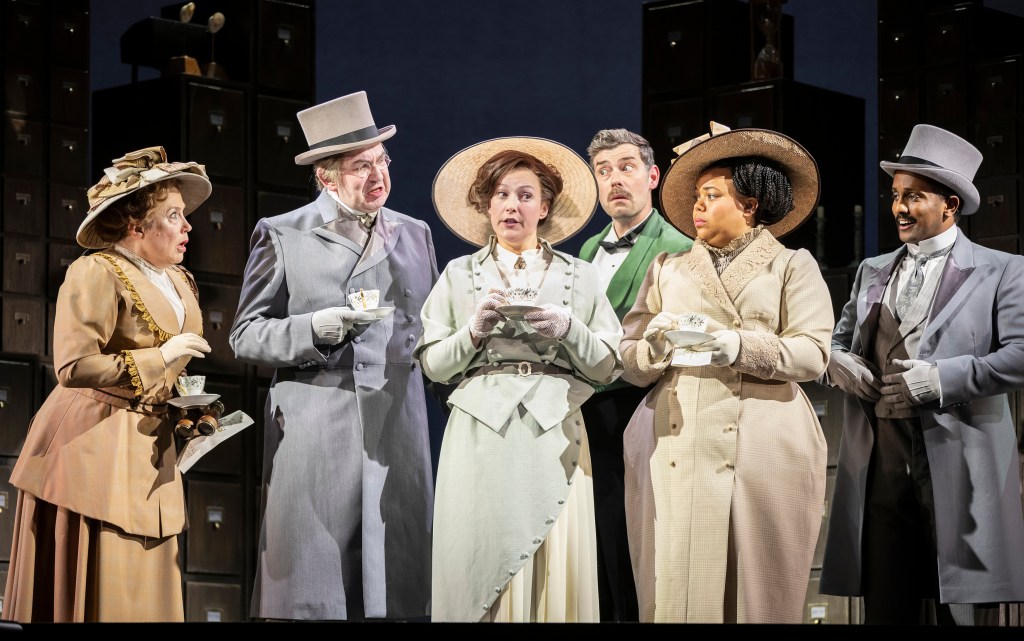
The company at Royal Ascot with Katie Bird as Eliza Doolittle, centre.
A few weeks later Eliza is judged to be ready and taken to the Embassy Ball, where she attracts another phonetician, this time a Hungarian, Zoltan Karpathy. The event is such a success that when they get home and crack open the Champagne, Col. Pickering concedes that Prof. Higgins has won the bet and the two men celebrate, totally ignoring Eliza who has now seemingly served her purpose. This obviously upsets her more than somewhat as she is the one who has done all the hard work, so she packs her stuff and leaves to find Freddy.
This is the point at which I took my leave as there was a slight lull and I had realised that I wasn’t able to stay the course.

The company at the Embassy Ball with John Hopkins as Professor Higgins and Katie Bird, Eliza Doolittle at the front.
An on-line synopsis tells me that when she returns to Covent Garden she no longer feels at home there. She sees her father who tells her that he has received a bequest from an American millionaire which has elevated him to the middle classes. Accordingly he feels that he should marry Eliza’s mother and make honest women of them both.
Higgins finds that he is missing Eliza and Pickering is worried about her well-being, so he contacts the police and enlists the help of an old friend to track her down. She is discovered at Henry Higgins’ mother’s house when he goes to pay her a visit. She says that she no longer needs him and he returns home despondent.
When he arrives at his house he plays a recording he made of Eliza’s first lesson and discovers how hard he had been on her. Suddenly, Eliza arrives and, full of joy he greets her by asking ‘Where are my slippers?’ This refers to an earlier episode during the training when they were in the middle of a row and he asked the same question, only to have Eliza throw the footwear at him in disgust. The end.
Never having seen the stage version before, my only yardstick was the film from 1966 which was a bit odd in that, although a musical, it featured actors whose singing wasn’t their strongest suit. Rex Harrison, as Higgins, talked his way through the songs, whilst both Audrey Hepburn, Eliza, and Jeremy Brett, as Freddy Eynsford-Hill, had their voices overdubbed by Marni Nixon and Bill Shirley respectively. This version, being co-produced by Opera North, had no such subterfuge.

John Hopkins as Professor Henry Higgins
Although best known as an actor, mainly for the part of Detective Sergeant Scott in Midsomer Murders, John Hopkins, who played Professor Higgins, has appeared in stage musicals before and carried off his songs very well. His acting skills were obvious by the way he delivered his lines and moved around the stage, especially in one scene when he was ascending a staircase – hilarious.
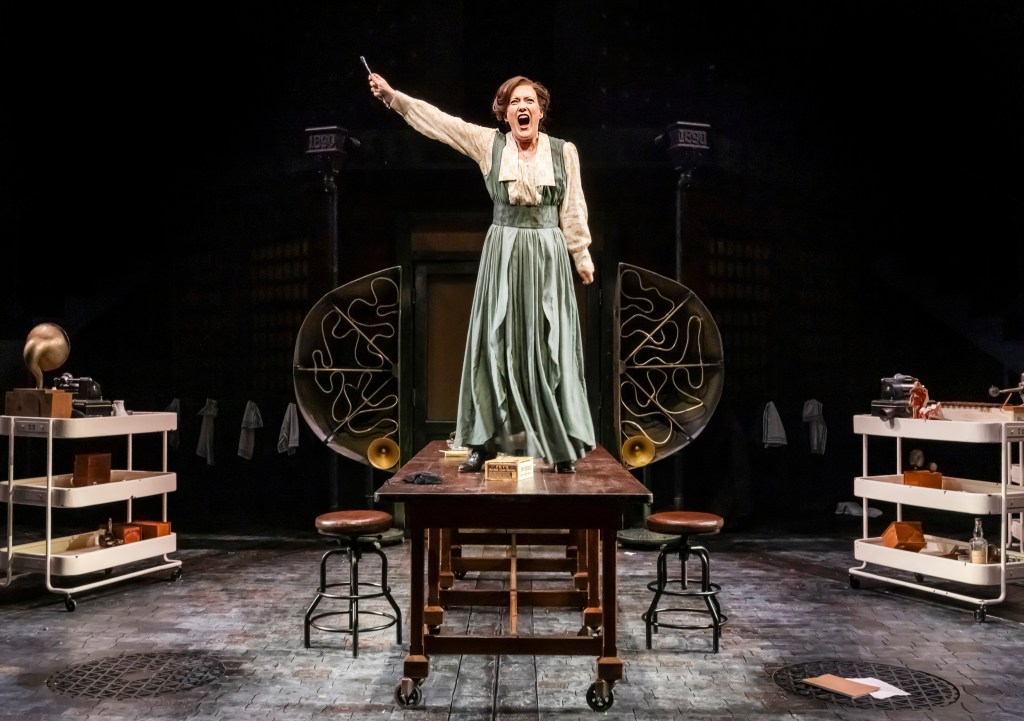
Katie Bird as Eliza Doolittle
Katie Bird is an opera singer, who has worked with Opera North before and, in direct contrast to the male lead, is a singer who can more than hold her own at acting. Her timing, movement and delivery were superb. She handled the transition from Cockney to posh brilliantly, as well as running the gamut of emotions from indifference, sorrow, frustration, annoyance and triumph through to feistiness. Her dancing was none too shabby either.
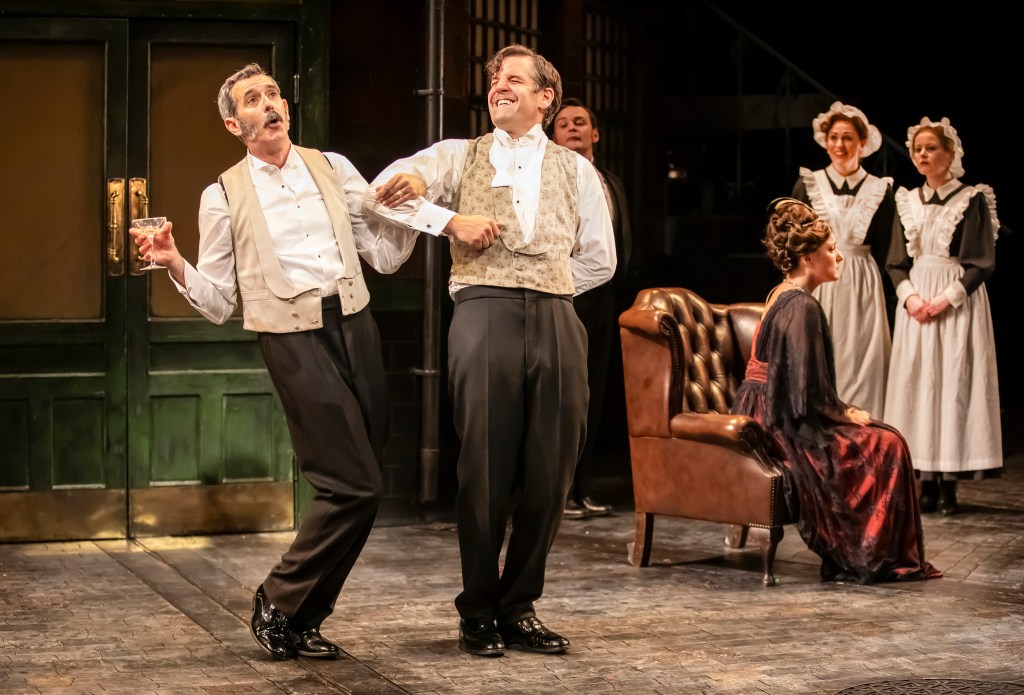
Dean Robinson, as Colonel Pickering with John Hopkins as Professor Higgins, celebrate their success while Katie Bird as Eliza Doolittle appears well short of impressed.
The part of Colonel Pickering involved very little singing which made me wonder why Dean Robinson, a stalwart of the Chorus of Opera North, had been cast to play him in preference to a specialist actor. I was soon given an explanation as he was very good indeed. He was the voice of reason between the sometimes hostile factions of Higgins and Eliza.

Richard Moseley-Evans as Alfred Doolittle
Richard Moseley-Evans, another opera singer, was perfectly cast as Alfred Doolittle, being a lovable rogue, despite his willingness to relinquish his daughter’s wellbeing to a stranger for a quick fiver. He belted out With A Little Bit Of Luck, energetically, but, sadly, I was not able to see him do his other feature number of the piece, Get Me To The Church On Time, as it was post trauma.
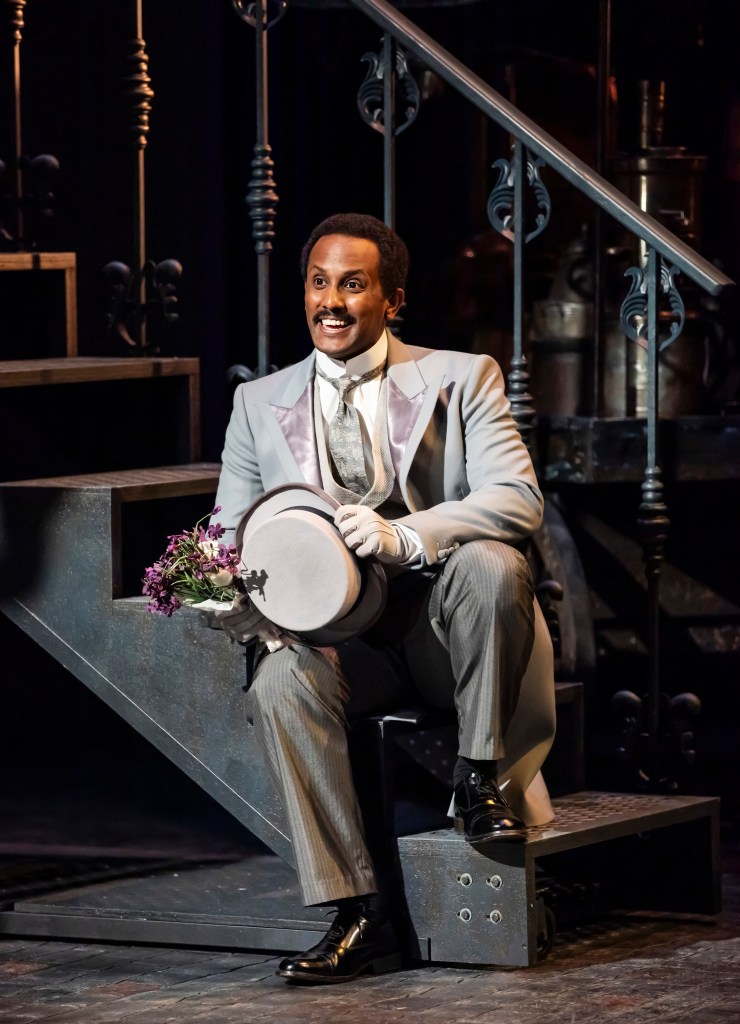
Ahmed Hamad as Freddy Eynsford-Hill
Ahmed Hamad is an actor with several musicals under his belt which was apparent in his handling of the role of Freddy Eynsford-Hill, the would be suitor of Eliza whose fairly timid personality probably cost him her hand. His rendition of On The Street Where You Live struck just the right balance between acting and singing, the sentiments contained in the song needing to be expressed more subtly than technically.
The only let down I found was the accents of some of the members of the chorus. The first big number is Why Can’t The English? during which Professor Higgins shows off his ability to Colonel Pickering by identifying various people’s places of origin by the way they spoke, in the case of Londoners, narrowing it down to within four streets. Whilst none of the chorus was in the same league as Dick Van Dyke, there were one or two who obviously were not from within four time zones of the capital! Actually I believe that Mr Hopkins himself had a lapse from posh to natural during the performance of You Did It, when he was acting drunk, but that is a very small nit to be picked.

The company.
The set, designed by Madeleine Boyd, who also created the costumes, was a very inventive affair, being utilised to represent everywhere from a Covent Garden street, through to the Ascot Racecourse, something which was done by means of a large mural of a formally dressed crowd with head holes cut out into which the singers inserted their faces whilst singing Ascot Gavotte. One of the spaces was the head of a small poodle only a foot or so off the ground, thus adding a touch of levity.
The orchestra, under Musical Director Garry Walker and the baton of Principal Guest Conductor, Anthony Hermus, which remained unseen during the time I was there, was up to the usual high standard of Opera North as, apart from the odd rogue Cockney, was the Chorus, led by Chorus Master Anthony Kraus.
I really can’t tell you how disappointed I was to have had to leave the show early, as I was enjoying it so much. I think that only Abraham Lincoln could have been more put out by the experience.
My Fair Lady, Directed by James Brining, is a Leeds Playhouse and Opera North Production and continues its run until 29th June. For more details and to make a booking, please go to https://www.leedsplayhouse.org.uk/event/my-fair-lady/
For future events at Leeds Playhouse see https://www.leedsplayhouse.org.uk/whats-on/
For Opera North it is https://www.operanorth.co.uk/whats-on
All photographs by Pamela Raith

